
Start with the traffic and operating model
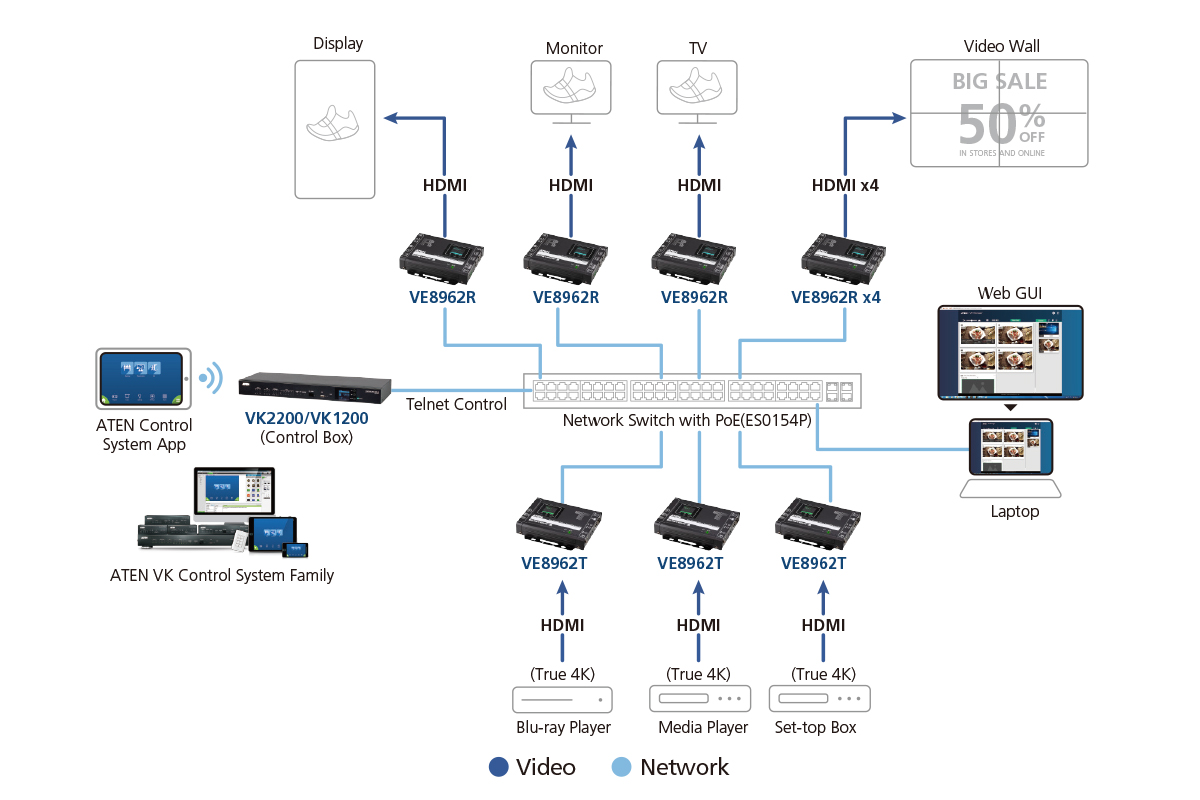
AV over IP moves video, audio, USB and control across Ethernet, but the network requirement depends on the chosen system. Some platforms use compressed streams on 1 GbE ports; others use higher-bandwidth links for visually lossless or uncompressed media. Audio, discovery, clocking and control may follow different paths from video. Record the expected bitrate per stream, the number of simultaneous sources and destinations, and the routes between switches before selecting hardware.
Define who owns each layer. The AV designer should state the media flows and endpoint requirements. The network team should approve switching, addressing, security and monitoring. The installer should certify the physical links and apply the approved configuration. A qualified AV integrator in China can coordinate these responsibilities, but should not invent network policy or make unrecorded changes to the client environment.
Decide whether the AV system uses dedicated switching, shared enterprise infrastructure or shared hardware with isolated logical networks. There is no universal answer. The correct model depends on scale, business risk, support capability, security rules and the manufacturer’s current design guidance.

Calculate bandwidth across the complete path
Port speed alone does not prove that a design will work. Calculate traffic on endpoint ports, switch uplinks, inter-floor trunks and any routed boundary. A one-gigabit encoder may create a stream that fits on its local port while several simultaneous streams exceed an uplink. Add headroom for control traffic, audio, USB extension, monitoring and normal variation rather than designing to the theoretical line rate.
Build a simple flow table listing each source, destination group, nominal bitrate, peak bitrate and expected concurrency. Test the busiest credible scenario: several rooms changing sources, a video wall subscribing to multiple feeds, or a town-hall overflow route becoming active. If resilience is required, repeat the calculation for the reduced-capacity state after a link or switch failure.
Switch backplane capacity, forwarding performance and buffer behaviour matter as much as port count. Confirm that the selected switch model and firmware are supported by the AV manufacturer for the intended topology. A generic statement that a switch is “managed” is not sufficient evidence.
Control multicast with IGMP, not assumptions
Many AV-over-IP systems use multicast so one source can serve several receivers without transmitting a separate copy to each destination. Unmanaged multicast can also flood every port in a broadcast domain. That wastes bandwidth and may disturb devices that never requested the stream.
The network design should state the required IGMP version, snooping behaviour, querier location, fast-leave policy and treatment of unknown multicast. Use one deliberate querier design per VLAN and verify that membership survives switch reboots and topology changes. Do not enable settings copied from another project without checking the current product documentation.
Test joins, leaves and source changes while observing switch counters. Confirm that a stream reaches subscribed receivers and does not appear on unrelated access ports. For routed multicast between VLANs or buildings, involve the network architect early; protocols such as PIM introduce design and security decisions beyond a single AV rack.
Use VLANs as an operational boundary
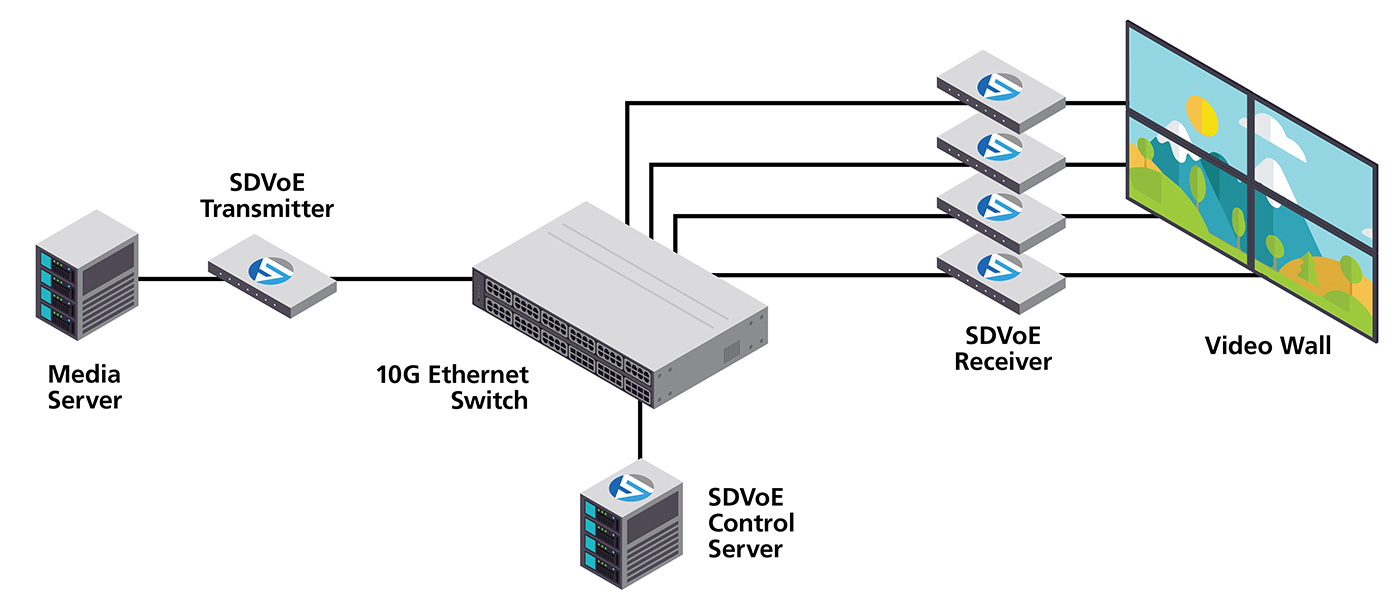
A VLAN can separate high-volume media and discovery traffic from general office devices while still using common physical switches. It is an operational boundary, not a complete security policy. Document which devices belong in each VLAN, which services must cross the boundary and which management systems require access.
Keep addressing, DHCP reservations, DNS, network time, certificates and remote-management paths in the design record. If endpoints use static addresses, reserve and document them so future network changes do not create conflicts. If control processors, touch panels or monitoring servers sit on another network, define the approved routed paths and ports rather than opening broad access.
Avoid an oversized broadcast domain simply because all endpoints share a product family. Segment by site, floor, system function or support boundary when scale and manufacturer guidance justify it. At the same time, avoid unnecessary routing between devices that exchange timing or discovery traffic frequently.

Align QoS, clocking and switch behaviour
Real-time media is sensitive to loss, delay variation and timing errors. Follow the selected platform’s current DSCP and queueing guidance, then map it into the enterprise policy. Do not assume that every AV protocol uses the same markings. Verify trust boundaries so priority tags are preserved, rewritten or rejected intentionally.
Audio networks may rely on Precision Time Protocol, while video platforms may use separate timing and discovery mechanisms. Establish where the clock leader can reside, how redundant paths behave and what happens after a switch restart. Disable or tune switch features that the product documentation identifies as incompatible; Energy Efficient Ethernet is a common example for time-sensitive audio networks.
Quality of service cannot repair an undersized link. Reserve priority for traffic that needs it, but first ensure that all links have enough capacity. During commissioning, collect evidence from endpoint diagnostics and switch interfaces rather than judging quality from one short demonstration.
Certify the physical network and label every path
The logical design depends on the copper and fibre underneath it. Specify the required cabling category, fibre type, connector, maximum channel length and certification standard for every link. Confirm PoE class and power budget where endpoints receive power from the switch. A link LED only proves that a connection negotiated; it does not prove margin at the required speed.
Certify installed links and retain the test files against stable cable identifiers. Label both ends, patch-panel ports, switch ports and field outlets using the same names shown on drawings. Photograph final patching before handover. These records shorten fault isolation when a room is changed months later.
Include spare switch capacity, optics and tested patch leads in the support plan. Spares should match the approved configuration and firmware path, not merely the connector type.
Commission user scenarios and failure states
Commissioning should prove the complete journey from source to destination. Test every approved route, expected resolution, audio format, USB function and control action. Then test concurrency: multiple sources, simultaneous destinations, rapid switching and the busiest video-wall layout. Record endpoint firmware, switch firmware, configuration exports and the network conditions used for acceptance.
Include failure tests that match the agreed resilience level. Restart an endpoint, remove an uplink where safe, reboot the querier, restore power and confirm that subscriptions recover. Check that monitoring detects the event and that support teams can identify the affected port and device. The AV commissioning checklist for China offices provides a wider room-to-handover framework for these tests.
For control rooms and other operational spaces, test information priorities, operator sightlines and incident workflows alongside network performance. Sinoway’s data-centre NOC and operations-room AV checklist explains why wall layouts, source permissions and recovery procedures must be accepted as one operational system.
Hand over a network that can be changed safely
The handover pack should include the approved topology, VLAN and IP plan, multicast design, QoS policy, switch-port map, cable test results, device inventory, firmware versions, configuration backups, monitoring method and recovery procedure. Separate confidential credentials from the general document set and transfer them through the client’s approved secure process.
Create a change rule for adding a source, receiver, switch or uplink. The rule should require bandwidth review, address allocation, port configuration, updated drawings and a short regression test. Without change control, a stable installation can fail after an apparently minor expansion.
Finally, assign owners for AV application support, network operations, manufacturer escalation and onsite response. A dependable AV-over-IP system is not only a topology; it is a maintained agreement between people, configurations and evidence.