
Start with the audio routes and operating model
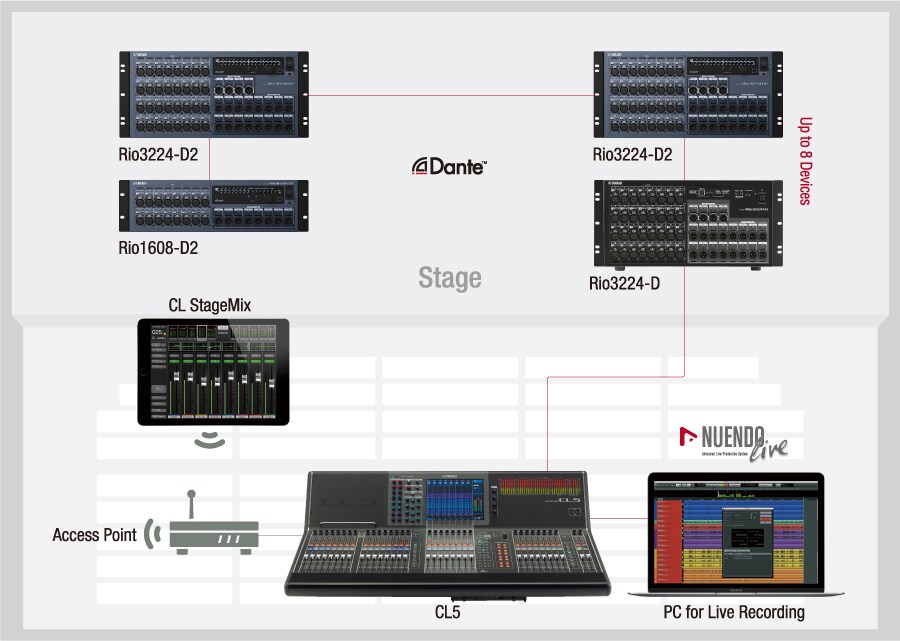
List every Dante transmitter, receiver and control workstation before choosing switches. Record channel count, sample rate, bit depth, expected unicast or multicast use, link speed, power method, firmware, physical location and the rooms or systems each device serves. The result should show both the normal route and the route expected during a failure.
Define responsibilities at the same time. The AV designer owns audio flows and device requirements; the network team approves VLANs, addressing, QoS, multicast and security; the installer certifies links and loads the approved configuration; operations teams own monitoring and change control. An AV integrator in China can coordinate these parties, but should not make undocumented production-network changes.

Calculate channels, flows and bandwidth across every uplink
Dante subscriptions create media flows rather than one independent network stream for every channel. Unicast is the normal method; multicast can serve the same channels to many receivers more efficiently, but it sends traffic throughout the relevant segment unless controlled.
Build a flow table showing source, destination, channel count, sample rate, bandwidth, flow type and concurrency. Check access ports, uplinks and routed boundaries, with headroom for clock, control, monitoring and expansion. Confirm calculations against each device’s current flow limits, link speed, latency guidance and firmware.
Treat PTP clocking as a critical service
Dante uses Precision Time Protocol to align device clocks. In a standard network, one suitable device is elected as leader and the others follow it. The election considers device capabilities and can be influenced by a Preferred Leader setting, but forcing a leader without understanding the topology can create a fragile system.
Record the expected leader, acceptable backup leaders and any external word-clock relationship. During commissioning, observe clock status while devices boot, subscriptions change and links fail. Investigate clock errors rather than masking them with higher audio latency. If AES67, SMPTE ST 2110-30 or multiple Dante subnets are involved, use the applicable Audinate architecture and boundary-clock guidance instead of assuming a single-VLAN design.

Apply QoS deliberately and disable Energy Efficient Ethernet
Real-time audio tolerates little packet delay variation. Audinate recommends QoS on mixed-use networks and defines Dante markings that can be integrated into enterprise policy. Clock traffic needs the highest treatment, audio and PTPv2 the next suitable priority, and other traffic best effort. If DSCP values are remapped, preserve that hierarchy end to end.
Confirm trust boundaries, remarking, queue allocation and uplink capacity with the network team; priority cannot repair an undersized link. Disable IEEE 802.3az Energy Efficient Ethernet on Dante ports because Audinate warns that it can disturb synchronization and cause audio dropouts. Review storm control, spanning tree and other power-saving features against current product guidance.
Control multicast with IGMP and use VLANs as boundaries
Small Dante audio networks with few multicast flows may not need complex tuning. Mixed networks, Dante video or substantial multicast audio should use intentional IGMP design: one elected querier per VLAN, suitable query and timeout values, and verified joins and leaves.
A VLAN limits broadcast and discovery scope but is not a complete security policy. Document the devices, controllers and management systems in each VLAN and the services allowed across it. The AV-over-IP network readiness guide explains the same principles for bandwidth, multicast, VLAN ownership and change control.
Do not copy switch templates between sites without review. Switch families differ in queues, IGMP defaults, firmware behaviour and management syntax. Retest after firmware or corporate-network changes.
Build real redundancy with two independent networks
Devices that support Dante redundancy send the same media over primary and secondary interfaces. Primary ports belong to one physical network and secondary ports to another; the two networks must not be joined. Connecting both interfaces to one switch or linking the two switch fabrics defeats the design and can create addressing or loop problems.
Use the same link speed on both interfaces of a redundant device, and connect non-redundant devices to the primary network only. Separate switches are necessary, but resilience also requires independent power, uplinks, optics, patching and routes where the risk assessment demands them.
Prove redundancy by removing one agreed link or switch path while audio is active. Confirm that media and clocking continue, alarms are raised, the failed component is identifiable and normal operation returns cleanly after restoration.
Plan addressing, access and safe network management
Dante devices normally obtain addresses automatically, and many systems operate with DHCP or link-local addressing. Static addresses add records, reboot steps and change risk. Keep primary and secondary networks in different IP subnets and avoid mixing addressing methods without a documented reason.
Limit management access to authorised workstations and accounts. Record controller versions, firmware, permissions and the route for remote support; transfer credentials separately. If Dante Domain Manager or routed domains are used, document domain membership, boundary clocks, authentication and recovery. Use device and channel names that match room names, rack labels and drawings.
Commission performance, latency and failure recovery
Commission every expected subscription, sample rate and audio format, then test the busiest credible state. Watch clock status, packet errors, bandwidth, multicast membership and device health while changing routes. Confirm channel order, polarity, gain structure and destination behaviour rather than accepting a green subscription indicator alone.
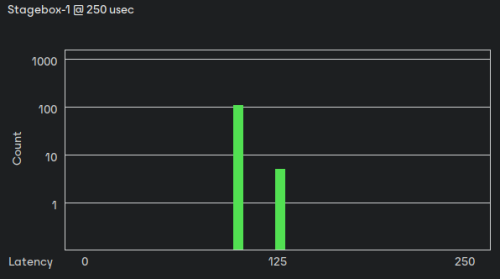
Dante Controller latency histograms show whether packets arrive before the receiver deadline. Green results with margin are healthier than bars near the limit; amber or red evidence requires investigation, more latency or network correction. Monitor long enough to capture normal peak use.
Test restarts, cable loss, switch loss where safe, leader-clock changes and restoration. Record evidence with the AV commissioning checklist for China offices so defects, retests, exceptions and acceptance owners remain traceable.
Hand over a network that can be changed safely
The final pack should include the signal and flow schedule, primary and secondary topologies, VLAN and IP plan, switch-port map, QoS and IGMP settings, cable-certification files, device inventory, firmware, clock-leader plan, configuration backups, monitoring method, failure-test results and support contacts.
Add a change rule for every new transmitter, receiver, multicast flow, switch or uplink. The rule should require capacity review, addressing, port configuration, updated drawings and a regression test. Dante reliability depends as much on controlled changes and clear ownership as on the initial switch configuration.